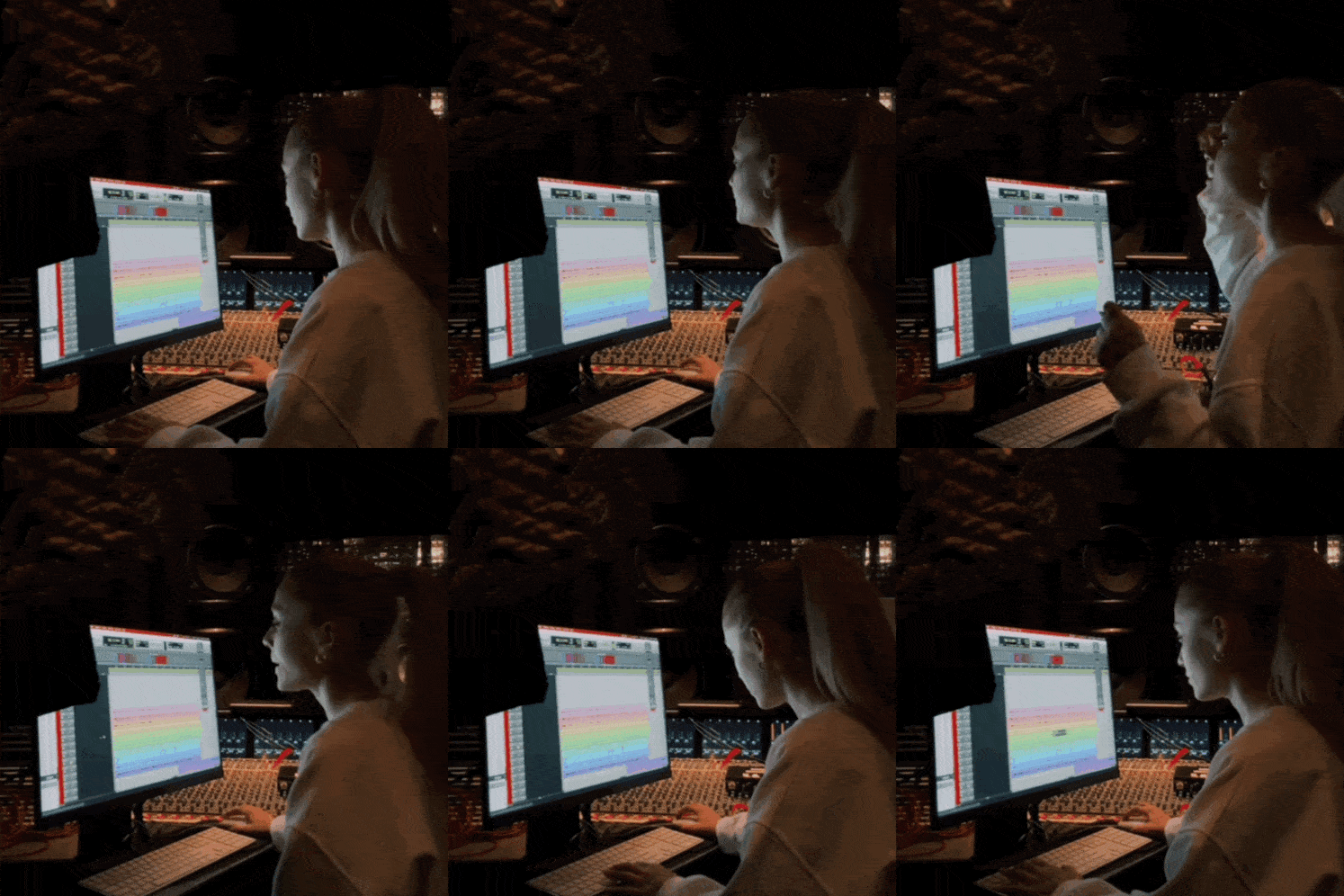
Universal Audio released LUNA 3.0 on September 15, 2026 with stem separation, audio-to-MIDI, lyric transcription and chord extraction among its new production tools. At first glance this looks like another DAW update built around AI features. The more interesting story may be what happens when those features are connected.
Stem separation itself is no longer particularly surprising. We have had increasingly capable systems for extracting vocals, drums, bass and other elements from finished mixes for some time.
What changes the workflow is what happens after the separation.
LUNA Studio can separate a stereo mix into six stems. Individual audio can then be converted into MIDI while Moises-powered chord extraction can analyse polyphonic material and place the detected harmony directly onto LUNA's Chord Track. LUNA Free receives four-part stem separation.
In other words we are starting to see a chain that looks something like this:
mixed audio → separated source → musical analysis → editable production data
And that is considerably more interesting than stem separation on its own.
From audio file to production information
Think about a reference track.
Until relatively recently a finished recording was largely a fixed object inside the DAW. You could listen to it, analyse it and perhaps use spectral tools to understand parts of it. Increasingly though the DAW can begin to reconstruct useful information from that recording.
A drum stem can become MIDI.
A harmonic recording can become chord information.
A vocal can become searchable lyrics.
A finished mix can become several independently processable sources.
Perhaps the important shift is that AI is moving away from being a collection of isolated generators and toward becoming an analysis layer inside the production environment.
The DAW is beginning to ask: What is inside this audio and how can we turn it back into something the producer can manipulate?
The next step could be the mix itself
This becomes especially interesting once we look beyond notes and instruments.
Research systems are already investigating representations of audio processing itself. Fx-Encoder++, for example, explores instrument-specific audio-effects representations extracted from complete mixtures with applications including effect parameter matching and intelligent music production. Other research such as WildFX investigates the estimation of processing graphs and plugin parameters from rendered audio.
That suggests a much more ambitious future workflow:
mix → stems → processing analysis → editable effects graph
We are not there yet. Reconstructing the actual EQ, compression, saturation, routing and spatial processing behind a professional mix is vastly more complicated than detecting chords or extracting drums.
Still the direction is becoming easier to see.
For decades DAWs have been designed primarily to turn production decisions into finished audio. Now they are beginning to move in the opposite direction as well: taking finished audio apart and translating it back into musical structure, editable data and potentially even processing decisions.
That is the more important story behind LUNA 3.
Stem separation may be the feature we notice today. The longer-term shift could be a DAW that does not simply play back audio but increasingly understands how that audio was made.
So the more interesting question may be this: how much of a finished production will tomorrow's DAW be able to reconstruct for us?